Work has always happened somewhere, long before it had offices. What keeps changing is what we do, what we ask that somewhere to enable, and how we create it.
Finding and shaping the workplace
Defining work is less straightforward than it sounds. A 5 km run can be someone's recreation or an athlete's work. Neither the activity itself nor whether it is paid defines work.
If work is hard to define, it is even harder to know when it started. However, anthropologist James Suzman offers a broad definition that helps: work is "purposefully expending energy or effort on a task to achieve a goal or end". This then lets us recognise work in the making of stone tools 3.3 million years ago, long before Homo sapiens, and the places where those tools were made as workplaces.
For hunter gatherers, where work happened depended on where food and other resources could be found. In that sense, the workplace was found. But it was also shaped. About 750,000 years ago, toolmaking and food processing were being organised into separate areas around a campfire.
Agriculture further intensified how we shaped landscapes for work, with cultivation developing around 11,500 years ago. Fast forward a few thousand years and crafts and trade happened in homes and workshops. Then, as Huppatz and I described in A short history of the office, religious institutions, governments and trading organisations later gave bureaucracies and hierarchies purpose built homes, the early archetypes of today's offices.
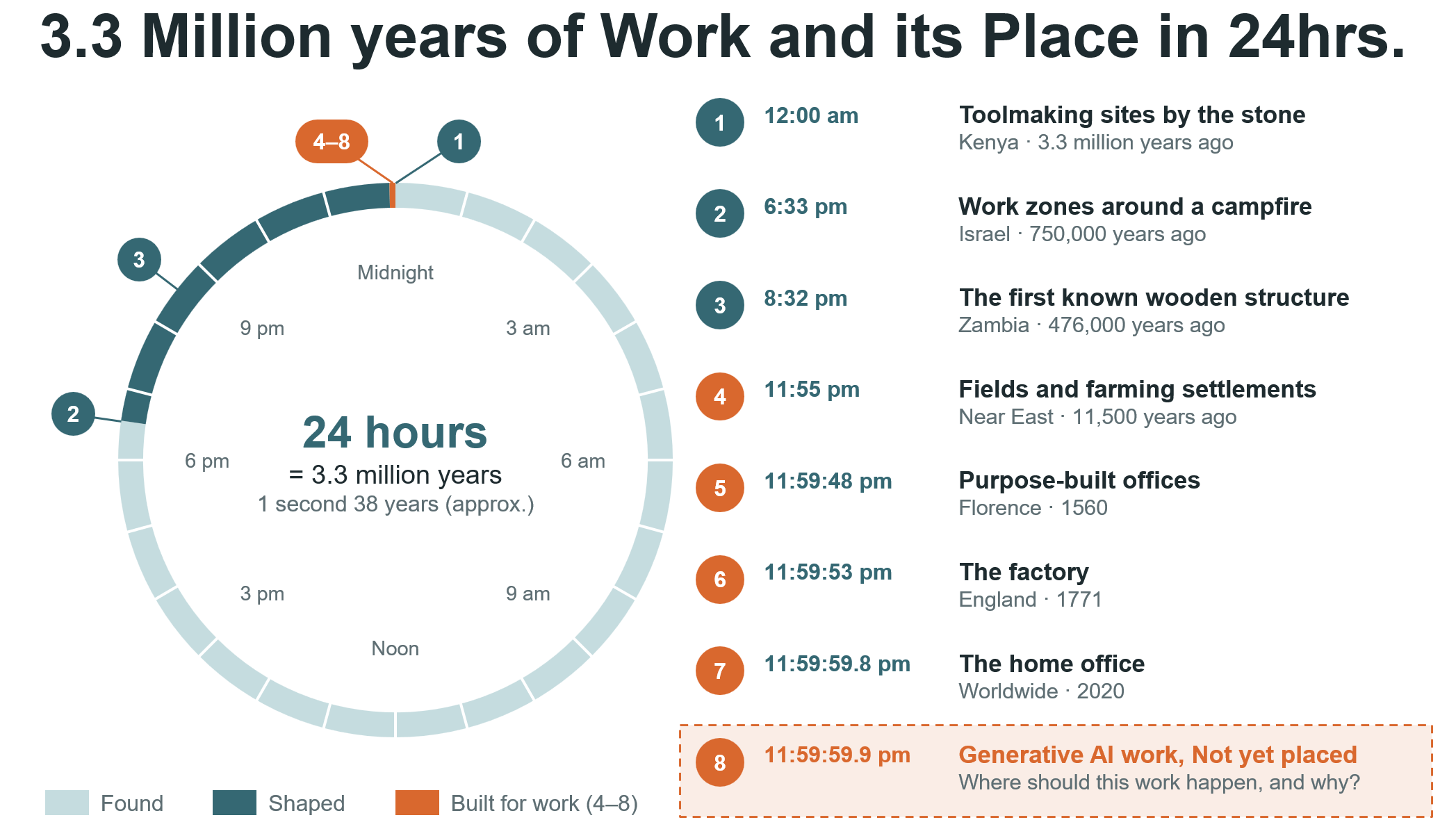
Now, imagine those 3.3 million years compressed into a single day. Toolmaking sites appear at midnight, work zones around a campfire at 6:33 pm, and the first known wooden structure at 8:32 pm. Farming settlements arrive at 11:55 pm. The Uffizi, built in Florence to house government offices, appears twelve seconds before midnight, the factory seven, and the home office a fifth of a second. ChatGPT arrives with 100 milliseconds to spare. AI is reshaping work itself, but unlike everything before it, it has yet to find its place.
Crafting a new era of work and place
Whatever definition of work we settle on, the division of effort between people and machines is changing. Machines have long taken on physical tasks, and computers have long assisted with knowledge work. But generative AI can now do work once thought exclusive to knowledge workers. One widely cited analysis finds that around 80% of workers have at least 10% of their tasks exposed to large language models, and higher paid jobs are more exposed.
That takes us back to Suzman's definition. As more of the effort behind work is shared with machines, or lost to them, depending on where you stand, I think we need to pay closer attention to the purposeful part of work: why we pursue a goal, and what makes the result worth having. Producing things is getting easier, but knowing what is worth producing, and why, is not.
This brings the responsibility of understanding why people work where they work, whether that place is an office, a home or somewhere else. When work can happen in several places, its location becomes a choice that needs a reason.
Occupancy is a cherished metric by those involved in workplace design and property because it is evidence about space use, and it is likely to remain central while workplaces are priced by the square metre and managed as a cost to be minimised. But it encourages us to focus on how much of the space is used, rather than what value it creates. A useful reminder here is that "presence" is not "performance" and an occupied desk can't tell us whether someone, or their work, benefits from being there, or whether the work itself should be done at all.
New tools + old assumptions = old outcomes
Using AI to design workplaces brings many responsibilities, but few more important than the assumptions we feed these systems. Those assumptions may be old even when the tool is new. If we make a fuller office the objective, that may be exactly what we get. This is Goodhart's law in practice: "when a measure becomes a target, it ceases to be a good measure". And a fuller office doesn't tell us much about why work belongs there.
For companies developing workplace strategy software, this carries particular responsibility. Work is changing, our role in it is shifting, and the tools used to shape its places are changing too. As philosopher Peter-Paul Verbeek argues, tools help shape the questions we ask, as well as the answers we get. These companies need to make their assumptions visible and open to challenge, because what they build now will shape the workplaces that follow.
That means building tools that start with different questions. Not "how many desks can we fit in?", but "for what type of work is this place for, and who is better off doing it here?" And not "how full is the office?", but "why is being together important?"
"Finding" gave work a location. "Shaping" gave it an order. "Placing" asks why people work there in the first place. For most of work's 3.3 million-year history, the question was where work could happen. Now that it can happen almost anywhere, the question is where it should happen, and most importantly, why.